Chronology
1909
William H. Calfee is born to Dr. Lee Price Calfee and Carrie Lavinia Whitehead in Washington D.C.
1926-27
Calfee studies with painter Jessie E. Baker in high school. She serves as his “initiation into painting as a creative and contemporary endeavor.”
1927-32
Calfee works as a stenographer during the day and begins to study painting and drawing at the Phillips Memorial Gallery primarily under the direction of C. Law Watkins and Olle Nordmark. These classes were conducted on the museum’s fourth floor and later an adjacent building would become known as Studio House in 1933. Meets Karl Knaths, Prentiss Taylor, Duncan and Marjorie Phillips.
1932-33
Calfee travels to Paris to study at the Ecole des Beaux-Arts. Studies with Paul Landowski. Visits the great museums of Paris and the studio of Auguste Rodin. While traveling in Italy, he develops an interest in early Renaissance fresco painting which he later explores with New Deal mural commissions and work in Haiti.

École des Beaux-Arts, Paris, 1932, Calfee (upper row, left) and fellow students in Paul Landowski’s sculpture class. Courtesy William H. Calfee Foundation Archive
1933-34
Upon his return to the US, Calfee briefly studies architecture at Catholic University, but soon changes course and enrolls at the Cranbrook Academy in Bloomfield Hills, Michigan. There he studies with figurative sculptor Carl Milles, learning both stone carving and bronze casting techniques. Graduates class of 1934.
1935
Teaches carving and painting at the Cumberland Homesteads in Tennessee for the Resettlement Administration, a New Deal agency. Marries Italian singer/dancer/model Maria Yolanda “Ariel” Peverini (later Hawkins), with whom he will have two children, Adriana and Richard.
1936-41
Returns to D.C. and wins several mural commissions for municipal buildings in Delaware, Maryland, and Virginia, and California under the auspices of the Treasury Section of Fine Arts, a New Deal arts program.
1939
Exhibits at the New York World’s Fair.

Sketch for a sculpture made for World’s Fair in New York, 1939.
1941
Artists’ Guild of Washington is founded, with Calfee as its first president.
Calfee mounts his first solo show at the James Whyte Gallery in D.C. The opening day coincides with Pearl Harbor day. Publishes “Suitability and Relationships” in the December 1941 issue of the Magazine of Art.
1942-43
Works in psychotherapy at St. Elizabeths Hospital, Washington, D.C.
Participates in the “Artists for Victory” exhibition at the Metropolitan Museum of Art.
1946
Following the death of C. Law Watkins in 1945, Calfee assumes the role of Chairman of the Art Department at American University and founds the Watkins Memorial Collection at AU. Collaborators and fellow faculty at AU include Sarah Baker, Robert Gates, Margaret Gates, Ben Summerford, Pietro Lazzari, and Martha Bigelow Eliot.
1949
Separates from Maria P. Hawkins.
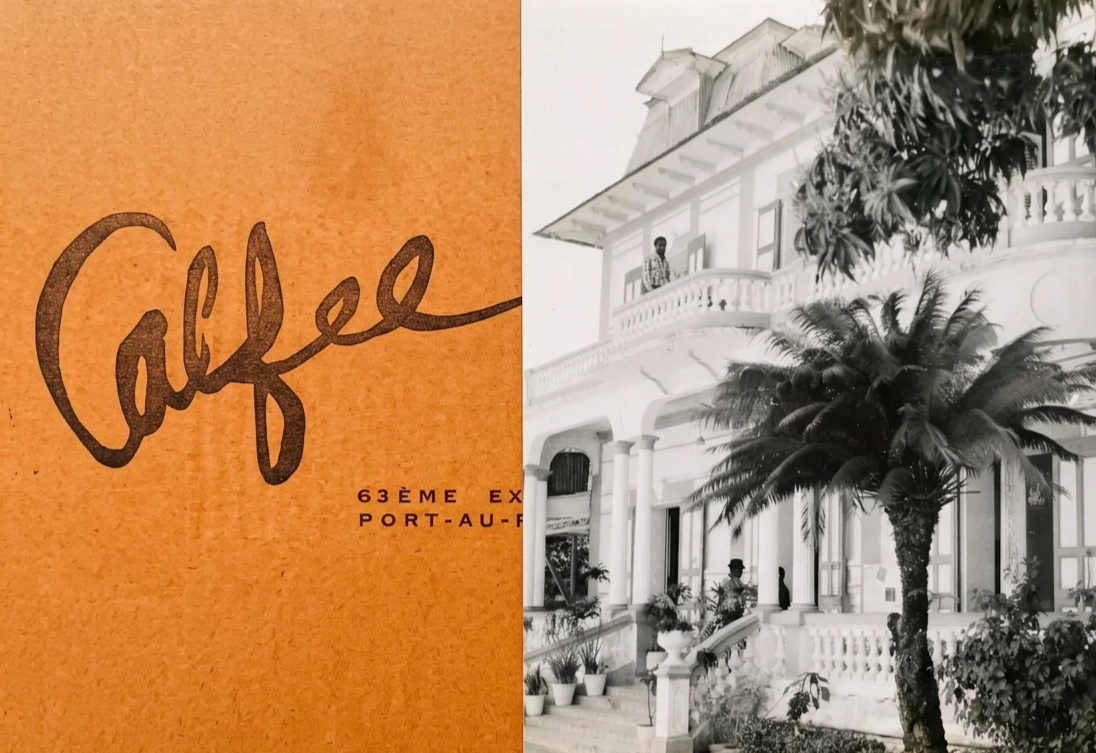
From February to April, he travels to Port-au-Prince, Haiti, where he teaches local artists techniques of mural painting at Le Centre d'Art, founded by painter DeWitt Peters in 1944. Calfee’s stay is organized by the writer Selden Rodman. The skills imparted by Calfee are used by local artists to create colorful murals of Episcopal Cathedral and in preparation for the December 1950 International Exhibition in Port Au Prince.
Le Centre d'Art in Port Au Prince exhibits a solo show by Calfee.
1951
Visits UC Berkeley as Guest Associate Professor in painting.
1950-55
Meets Gertrude “June” and fathers four children: Helme, Bill, Alan, and Julia.
1954
Retires as Chairman of the Art Department at American University in order to devote himself to painting and sculpture, but continues to teach intermittently.
1957
Co-founds The Jefferson Place Gallery in Washington, D.C. along with Robert Gates, Helene McKinsey Herzbrun, Mary Orwen, Ben “Joe” Summerford, and Alice Denney. The gallery is one of the first to exhibit artists from the Washington School of Color, including Kenneth Noland.
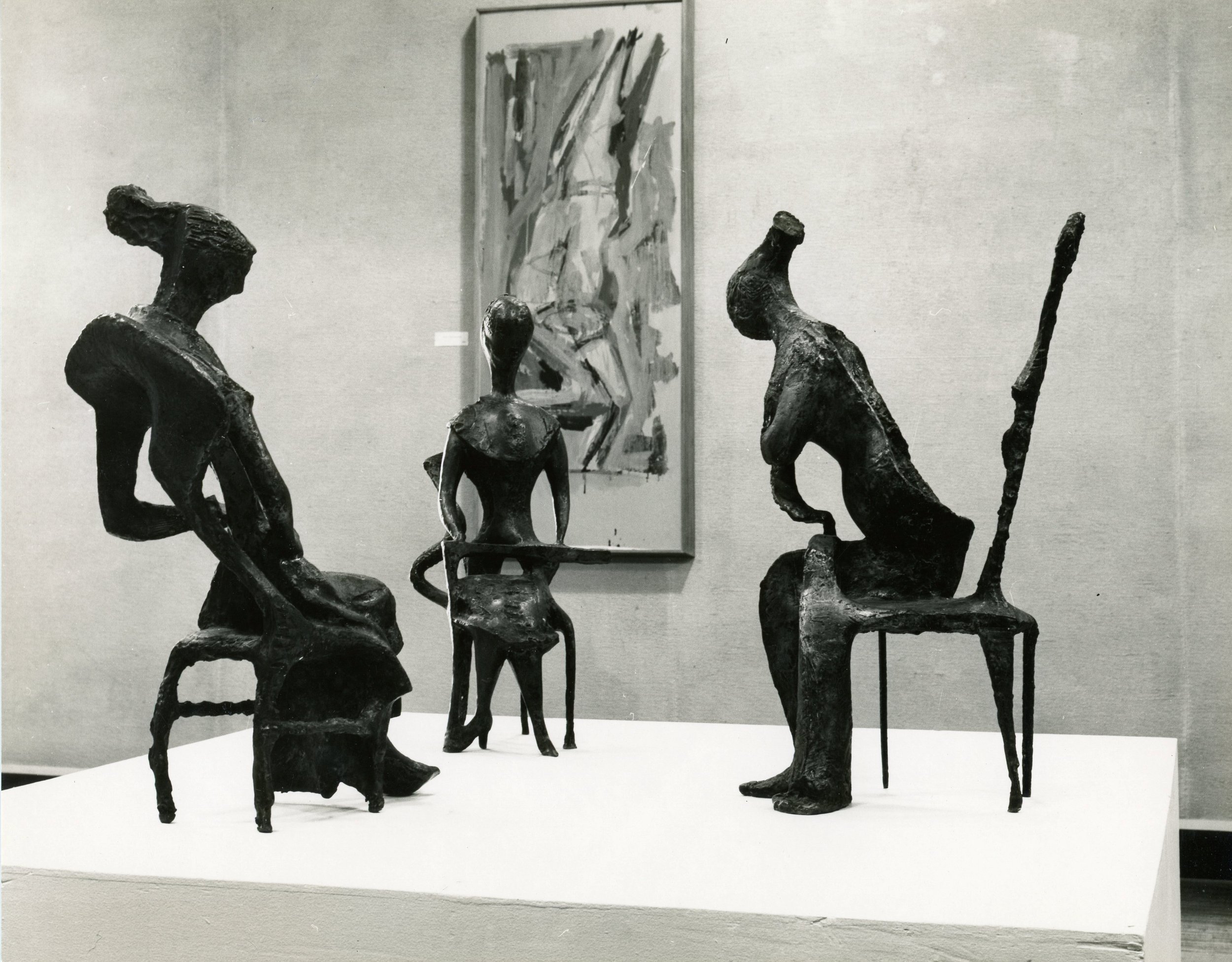
Figures in Conversation (1956) and Study for Orion (1958) installed at the Santa Barbara Museum of Art, 1960.
1960
Organizes solo exhibition of sculpture and painted studies for sculpture with the Santa Barbara Museum of Art. The exhibit travels to the McNay in San Antonio, Oklahoma Art Center, Phoenix Art Museum, Legion of Honor in San Francisco, and Roswell, New Mexico. Catalogue introduction by Jacques Lipchitz.
1961
Exhibits at the Carnegie International in Pittsburgh.
1966
1969
Exhibits at the Whitney Annual — the first hosted at the new 945 Madison Avenue building designed by Marcel Breuer.
Completes commissioned altar and font for St. Augustine’s Episcopal Church in Washington D.C.
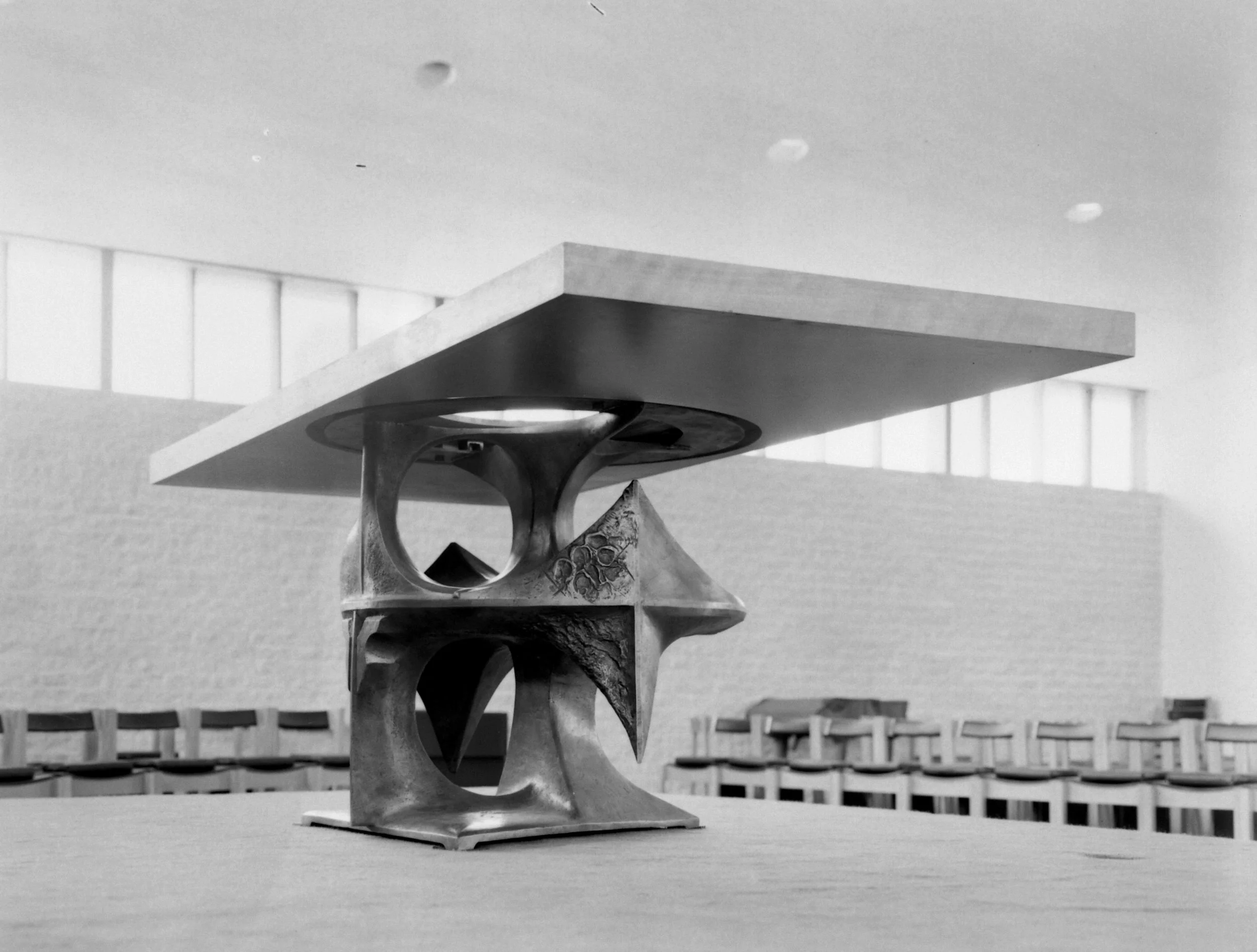
Completed altar at St. Augustine’s Episcopal Church, 1969
1977
Moves to Chevy Chase and retires from Professor Emeritus position at AU. Calfee and fellow-artist Patricia Friend organized the Kensington Workshop at which they taught their innovative approach to painting for a number of years.
May - August: Travels to the Brittany region of France, as well as Rome, Florence and Arezzo, Italy. In Arezzo, he visits the studio of Giorgio Vasari.
1978
Mounts a retrospective exhibition at the National Academy of Sciences.
1979
Receives an honorary Doctorate of Humane Letters from American University.
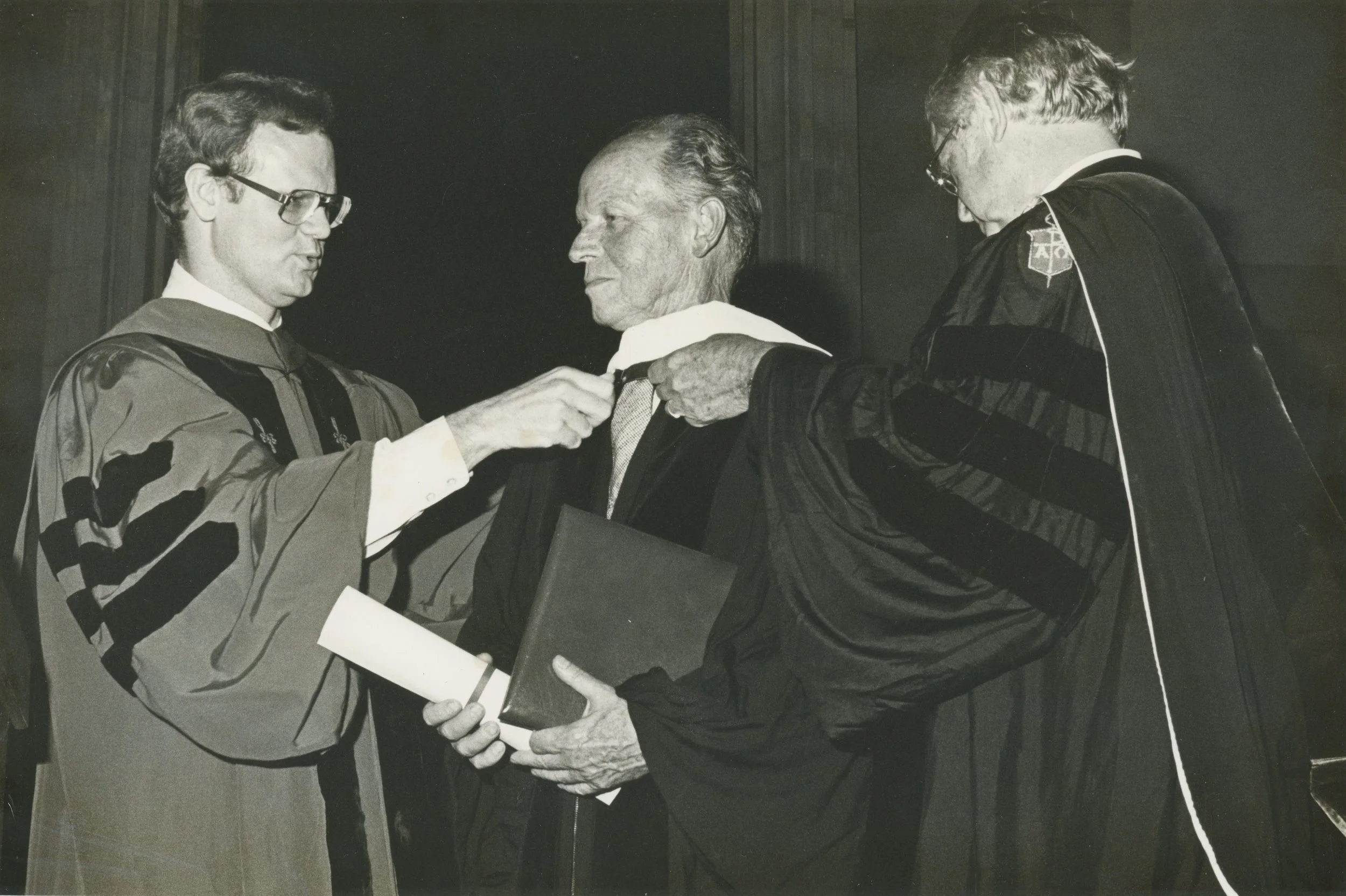
Calfee receives Honorary Doctorate, 1979.
1980-81
Installs major public sculpture commission at the Rockville Civic Center Park, F. Scott Fitzgerald Theatre in Maryland.
1983
Exhibits with Patricia Friend at Graham Gallery, New York City.
Serves as Professor Emeritus, Art Department, The American University, Washington, D.C.
1986
Revisits the Etruscan tomb in the Villa Julia in Rome where as a young man he had admired a terra cotta sculpture there of a man and woman. This scene influenced the painting “My Personal Etruscan Couple.”
1995
Calfee passes away December 2nd.