This article serves as a republished archive of an article initially published in Magazine of Art on December 10, 1941.

SOME YEARS AGO a sculptor in Florence made me acquainted with the phrase “sensitivity to relationships.” While it did not mean a great deal to me at the time, I sensed its importance. Since then its meaning has come to have more and more significance for me. In all my striving to live fully, to produce a first rate painting or sculpture, I have in moments of reflection returned to the fundamental thought implied in this expression. For no matter what the environment, the material, or the particular vocabulary of form at the time, good sculpture has been the result of a man’s sensitivity to the relationships existing between the three-dimensional shapes used in expressing an idea. And so it is with coloring of flat surfaces called “painting”. And so it is even with the manipulation of a series of events which we call “life.”
My early years were agreeably average. It seems that I have always drawn. Most children do. Probably more would carry their interest in art through adolescence if they were thrown into contact with it as a thing as normal as writing and had a few materials within reach. My father drew beautifully and I still have several specimens of his animals carved from soft woods, generally laminated cigar boxes. These were ingeniously provided with leather tails and ears and each seized the character of the particular animal in a simple, understanding manner.
I suffered the handicaps of most American artists in that I went into my trade, unlike the old craftsmen, after four or six years of general education. I wonder if teachers are to blame in turning such fascinating subjects as history, mathematics, and literature into a form of drudgery by removing them completely from association with life, past or present. There was, however, Miss Jessie Baker, one teacher of art in a Washington high school who has proven a vital stimulus to a number of her students. She knew what was going on in the world of painting and sculpture. Miss Baker was the high priestess at my initiation into painting as a creative and contemporary endeavor. After wandering through a number of college classes, I finally decided to live this one life insecurely, but as I pleased, and not as those careful of my future were planning.
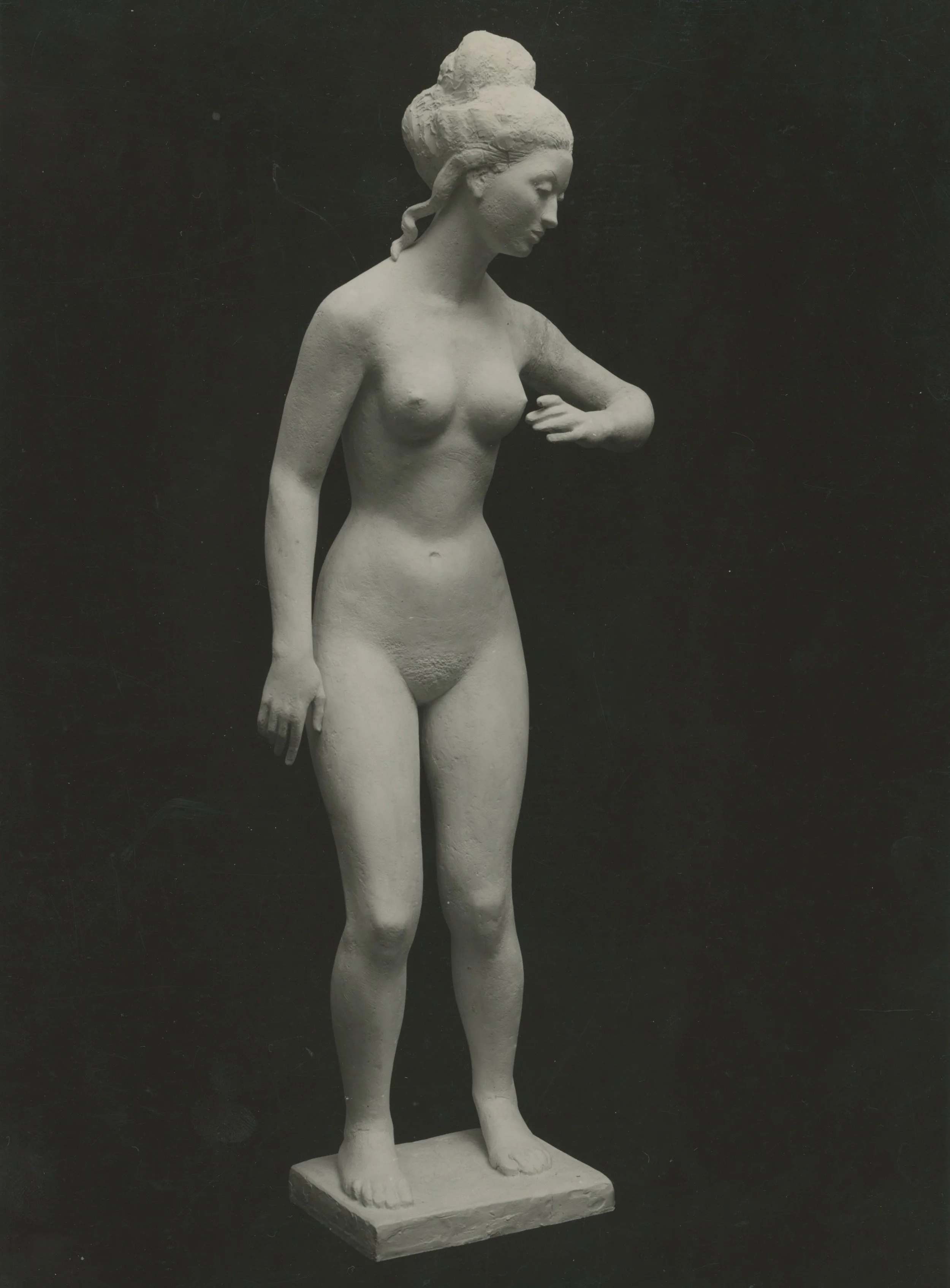
Little Woman, c. 1939
Plaster model for bronze
H. 36 in. (91.4 cm)
However, being a somewhat practical person I didn’t stop eating or move into a garret while I was learning more about the arts. I painted at night and after office hours during the year that I held a stenographic job in the government. Lunch hours I drew trees outside the window, or went most often to the Phillips Gallery, which was then about the only place. in Washington where one could see a painting dated later than 1880. The money saved from this job took me to Europe. Even before the present war we began to realize Europe was not an artistic necessity. But about ten years ago it was still a “must” for aspiring talent.
Conversations with people my own age, the usual discussions of art, during the next eighteen months in France and Italy seemed always to come back to one point. We felt that there must be some basic reason for the successful expression that we found in those pieces of sculpture or those paintings which we considered good, whether they were modern or old. “Why,” we asked ourselves, “if we are able to discriminate between the good and the bad, are not more of us able to achieve distinction in our own work?” Although I did nothing in the studio at the Beaux-Arts except model in clay from life, through association with painters and other artists I began to understand the interrelationship of all the arts. Back in the United States, the next year I followed almost the same course I had pursued in Europe, modeling at an endowed Washington school. The real achievement of that time was knowledge gained by the study of architecture at Catholic University. I found increasing occasion for disagreement with the instructor of our modeling class on the subject of composition. | knew something was wrong with his point of view. But it was not until the following year when I went to work with Carl Milles that the dawn broke.
The answer to my seeking for a fundamental was “suitability to the material used.” This discovery was added to the realization that “sensitivity to relationships” inferred seeing anything as a whole with all parts related to and functioning as a part of it. Incidentally, Milles also made me aware of the necessity for discrimination in the manner in which the hours of each day were passed.
My life and work became more determinedly set in the one direction I had hoped for. From then on I was on my own. From then on my basis for judgment was: sincerity, taste (the ability to relate objects to each other), and suitability to material. Granting the need of the technical knowledge and skill necessary to put thought into concrete form, there seemed now to be a base upon which to grow. With this measuring rod I could face the accumulation of art that we have inherited from the past, without confusion. I could view the various modern phases and adaptations to current use of old forms without wondering which was right. I found that old or new, abstract or objective, could be either good or bad by the same standard.
My conviction is that the simplest part of any art is learning the use of its specific tools. Anyone with average intelligence can learn to draw. I did not say draw well. Anyone can run a wash, or chip pieces from a stone, or take a brush and put color mixed with a little turpentine or varnish on a canvas. The reason that most beginners cannot paint a portrait or landscape well is that they cannot see the thing they are looking at as an expressive whole, with each part in its correct relationship. The reason that most young sculptors cannot model or carve is that they do not conceive of their design as a three-dimensional geometrical unit. It is not that they cannot take the chips off the wooden block, but that they don’t know where to take them off!
After making the statement that “anyone can draw or carve or paint”, even after becoming aware of my simple standards of judgment, please do not think that I have forgotten one awful final thought: Has he, the artist, have I, anything to say? I will not concern myself with that question. Who would be the judge? An artist considers himself his only judge. Since he is a seeker after truth, the closer realization of what is true to him is increasingly beautiful to him.
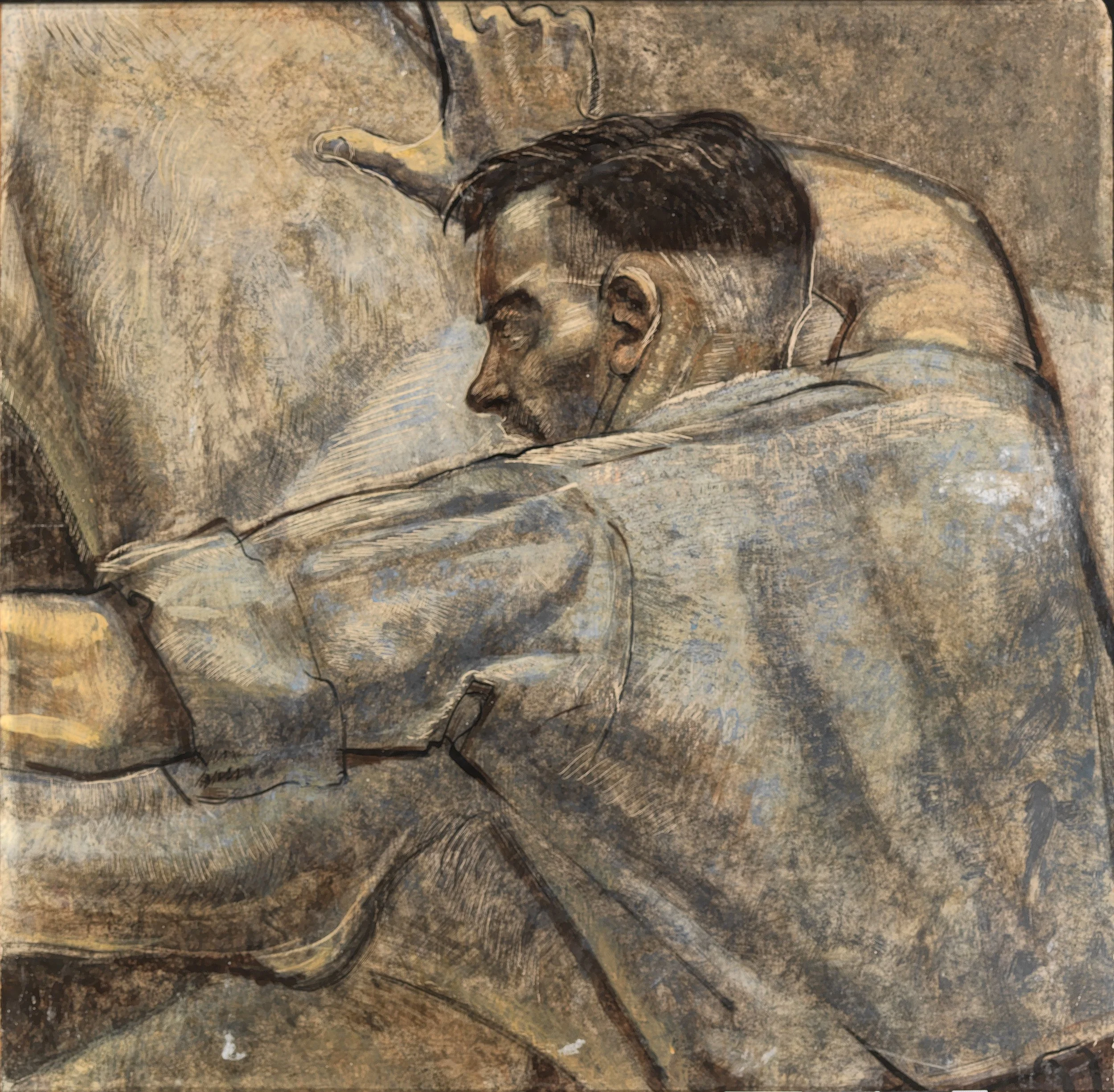
William H. Calfee, Country Fair and Trading, Court House Square (mural study, Harrisonburg, Virginia Post Office), ca. 1942, oil on plywood, 24 x 24 in. (60.9 x 60.9 cm), Smithsonian American Art Museum, Transfer from the General Services Administration
I do not argue that I am a good painter. I say simply that I enjoy painting and intend to continue with it, as well as to carve and model. Fortunately, some others have enjoyed my work too, and their moral and financial backing has not only strengthened my conviction but enabled me to continue purchasing supplies with which to pursue my work.
My first large painting, done for the Section of Fine Arts, shows the transition from sculpture to mural painting. This was done after the Special Skills Division of Resettlement folded up and I lost a job teaching carving and painting at one of its projects, Cumberland Homesteads. Much of my time on this job was my own. I did a number of small figures of people in the fields, planting, sowing, cutting trees, all sculpturesque movements. Receiving the announcement for a mural competition in Petersburg, Virginia, I took some of my notes for sculpture, grouped them in what I now consider a too symmetrical manner, painted a landscape behind them, colored the figures and sent in the design. I won the competition. This was a large job. I had no former experience with mural painting, but had seen and worked on sculpture much larger than that. I had heard Carl Milles mention that having made a basic design in small scale one should not vary from it in enlargement. Olle Nordmark told me why monochromatic underpainting would hold a large format together. I believed in him enough to take his suggestions by proceeding to lay in flat areas of color over the underpainting before modeling. I did a second mural with the same process although it turned out to be more of a "painting," and began to use this underpainting process in smaller compositions. Numbers of times at that period I was slapped into alertness by the comment of some knowing person that I was showing off in my painting; that I was not as much interested in painting the person behind the face as in showing a knowledge of the anatomical structure or in grading the tones and values correctly to get a surface likeness. I was accused of producing colored drawings.
My painting as painting was worse, although I knew more, than it was years before! Several discussions of myself with myself convicted me of gross. neglect of my discovery of "a basic truth." I was trying to produce well-drawn colored objects instead of putting paint, oil paint, on a canvas in a manner which was specific to oil, not tempera or watercolor. Law Watkins and Karl Knaths have done much to make me conscious again of the element of suitability, which I try never to neglect. Succeeding work on large paintings has led me into using egg tempera as an improvement over thin oil for underpainting. My latest efforts indicate that I have grown into the use of the more restricted range in value and tone, and the mat surface of tempera as being more suited to painting on a flat wall.
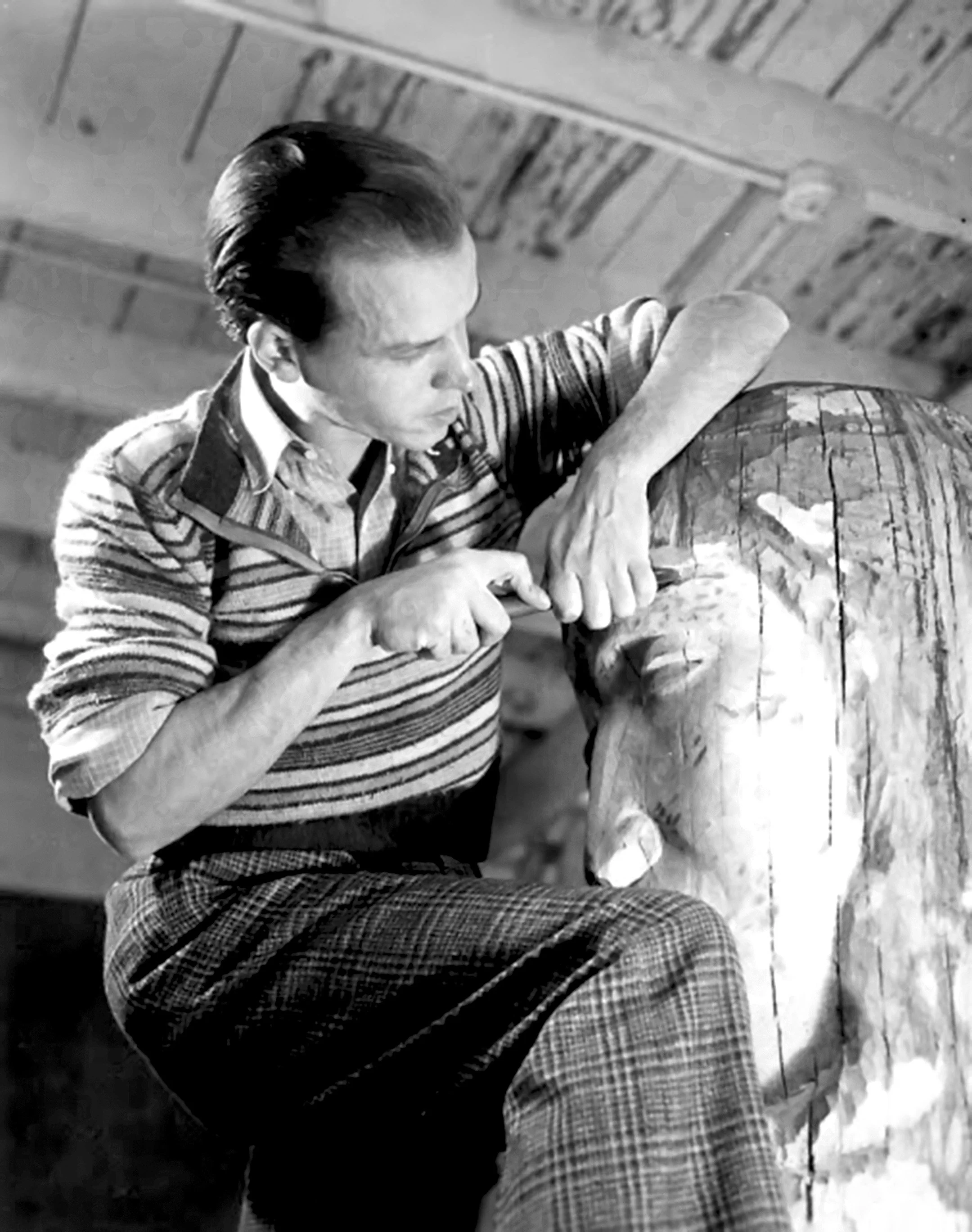
William H. Calfee
– working on Druid, c. 1938
Admitting that I have the symptoms of a mental condition whose earmarks always remain the same: the inability to remain inactive, the desperate hope that each new work may be better than the last, the acceptance of continued cycles of exaltation and despondency—admitting these characteristics which exist in the novice and the master. I consider myself one of the more fortunate products of our contemporary society. I never cease to be pleased when someone says that he too enjoys one of my works. I feel terrifically indebted to the present administration for enabling some of us artists to live as a functioning part of a community.
The fact that some people now call me a painter and others call me a sculptor is the result of a series of events which to date have followed in a peculiarly logical sequence. One might call this progression luck, but inevitably I have had something to do with it, for as various cross roads were approached my final decision has had to be arrived at regarding the direction to be taken. To me an artist's life and his work are one and the same thing. To bind this statement, I believe that a man may be truly religious without admitting one or another man-made creed. Man's true relationship to man needs no term denoting a political system.
The present-day artist is an assimilator of styles of art from many lands and eras. It is necessary for him to be an assimilator who is able to draw forth fundamental troths, He is the forerunner of an international man—a constructor, a discriminator, one who avows his faith by his every deed and who can no more renounce his conviction toward order and construction than he can automatically remove his heart; or perhaps no more than a person born or raised a "destructionist" can suddenly be expected to renounce his blood and background and begin to place objects in a more suitable relationship to other objects rather than tear them apart.